Numerical Intelligence

A foundational pillar of artificial intelligence alongside linguistic intelligence.

“There are, indeed, things that cannot be put into words. They make themselves manifest.”

— Ludwig Wittgenstein, Tractatus Logico-Philosophicus, 6.522

What it means

Intelligence beyond language.

What is numerical intelligence?

Intelligence is the ability to acquire knowledge, adapt to unfamiliar situations, and solve new problems. While modern AI has largely focused on language, true intelligence is not confined to words. Numerical intelligence extends this cognitive capacity directly into the measurable world. It is the ability to perceive raw numerical data, instantly deduce the underlying mechanisms, and reason about complex systems without relying on linguistic translation.

How is this different from conventional methods?

Traditional deep learning often absorbs a specific system's rules directly into the model’s weights. This approach effectively memorizes a fixed scenario and demands costly retraining for any new application. Numerical intelligence fundamentally breaks this mold. Like Large Language Models, it extracts knowledge instantly from numerical prompts. Its weights serve as a generalized reasoning engine, empowering the model to understand and predict entirely new systems based solely on the measurements supplied at inference, eliminating the need for retraining.

Why is this important?

The systems that shape science, society, and business, from climate and energy to cities, markets, and supply chains, are continuously revealed through measurements. The ability to rapidly understand how these systems behave, predict what comes next, and guide action can turn changing data into timely decisions. Numerical intelligence is therefore indispensable to a future AGI ecosystem, giving artificial intelligence a direct capacity to understand, predict, and act on real-world systems.
Research foundation

Numerical reasoning across unseen systems.

Cross-disciplinary generalization.

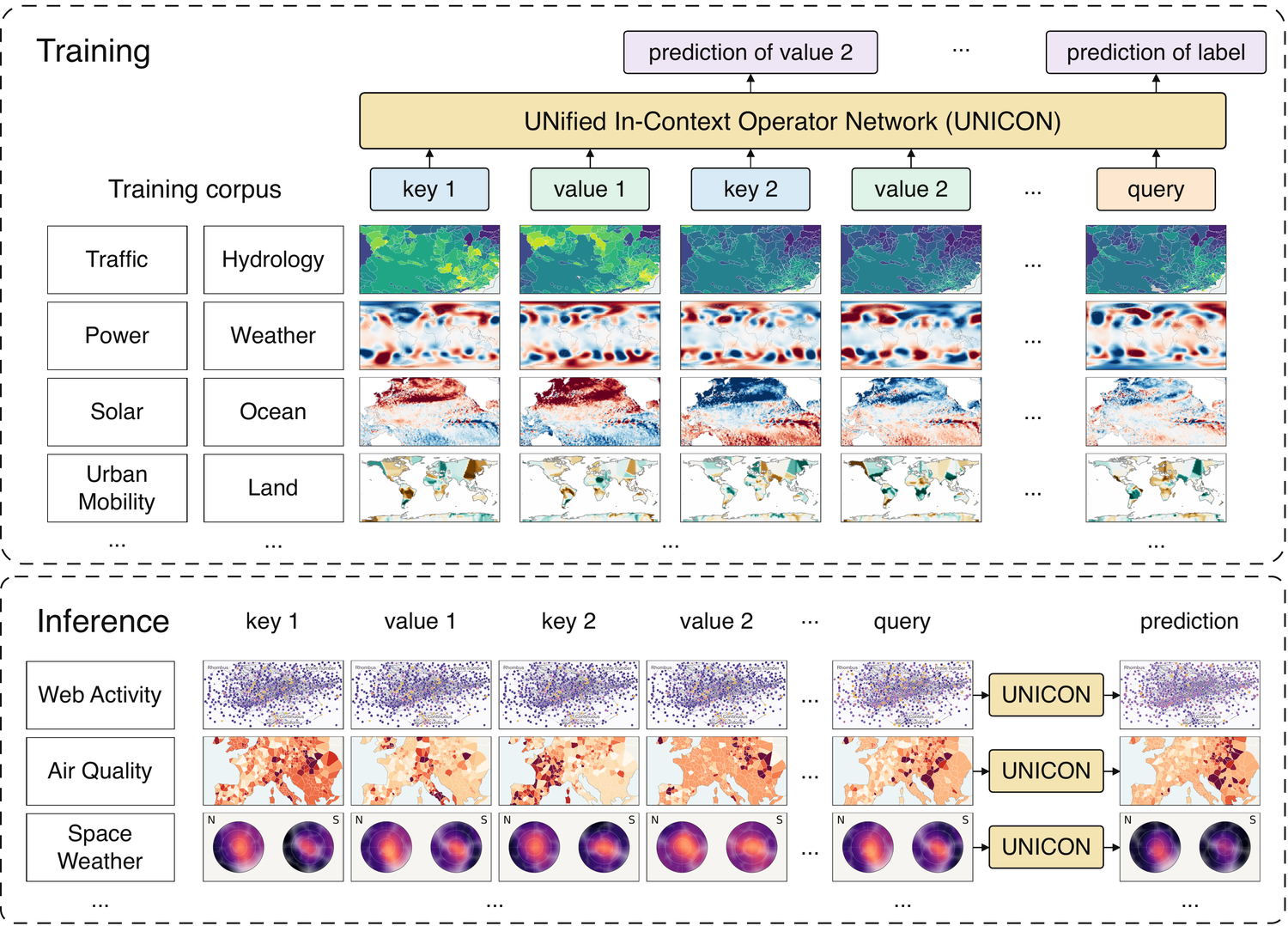
Our proposed In-Context Operator Network (ICON) is an early demonstration of numerical intelligence for forecasting across scientific and social systems. Trained on datasets across diverse domains, including traffic, hydrology, power, and urban mobility, ICON can generalize to new disciplines entirely absent from its training data. By reading new data as a numerical prompt rather than requiring retraining, it adapts to unseen fields like web activity and air quality, and can even beat state-of-the-art models trained specifically for those tasks.

Programmable inference harness.

A dedicated inference-time program, acting as a harness similar to those in linguistic intelligence, orchestrates calls to a frozen numerical intelligence model alongside explicit mathematical operations. It transforms numerical prompts, quantifies uncertainty, and enforces hard rules. This programmable layer unlocks the full potential of the foundation model without a single weight update.

Powered by automated research.

To accelerate the development of numerical intelligence, we built an automated research system where co-evolving agents iteratively improve core model architectures, refine training methods, and optimize the inference harness. This continuous self-improving loop dramatically scales our research capacity, allowing us to push the boundaries of numerical intelligence at AI speed.

UNICON training across scientific and social systems and inference in unseen disciplines.
Figure 1. Unified In-Context Operator Networks (UNICON) trains across scientific and social systems, then generalizes to unseen disciplines.
  • Liu Yang, Siting Liu, Tingwei Meng, and Stanley J. Osher. “In-Context Operator Learning with Data Prompts for Differential Equation Problems.” PNAS 120(39), e2310142120 (2023). doi:10.1073/pnas.2310142120
  • Chenghan Wu, Zongmin Yu, and Liu Yang. “A Foundation Model of Numerical Intelligence with Cross-Disciplinary Generalization.” arXiv:2607.28432 [cs.AI] (2026). doi:10.48550/arXiv.2607.28432
  • Zongmin Yu and Liu Yang. “Evolving Ensemble of Agents.” arXiv:2605.09018 [cs.NE] (2026). doi:10.48550/arXiv.2605.09018